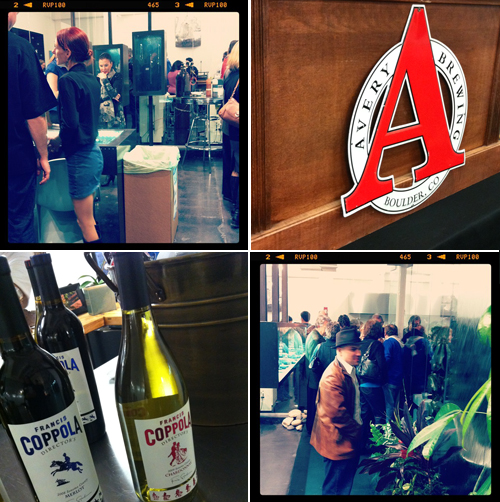
Our wonderful Workshops and Panels Coordinator Donna Crain grabbed these images at our Program Release Party on Thursday. It's the annual event at which members, sponsors and community representatives are given an exclusive sneak peek at our program for the year.
This year, the event was staged in a unique and beautiful venue -- that of the jeweler Todd Reed Gallery at 2015 Pearl Street. Thank you to Todd Reed (toddreed.com), and to Francis Ford Coppola wines, Avery Brewing, and Zoe Ma Ma for sponsoring our event. The performance by the Lemon Sponge Cake contemporary dance troupe was spectacular as well! And, as you can see, the party was a blast.
We're incredibly excited by this year's films and special guests. We will be announcing the posting of the 2012 schedule, along with tickets sales for all events, within hours. Stay tuned!
Here's a little tidbit for you, BIFF fans -- the Boulder International Film Festival is proud to announce that it will host the Colorado premiere of Luc Besson's new feature film, "The Lady"! This biopic of Burmese political leader and Nobel Peace Prize winner Aung San Suu Kyi stars Michelle Yeoh ("Crouching Tiger, Hidden Dragon") and David Thewlis ("Naked," "Seven Years in Tibet," Professor Lupin in the "Harry Potter" series).
The film follows the life and struggles of the woman whose opposition to the ruling military junta meant that she was destined to be separated from her family and subjected to house arrest for more than 20 years.Luc Besson is best known for his fantastic adventure films -- "La Femme Nikita," "The Professional," "The Fifth Element" -- but he has also essayed documentaries ("Atlantis") and historical dramas "The Messenger: The Story of Joan of Arc").
We are so excited to be part of this film event! More details, and more info on films and filmmakers coming to BIFF 2012, coming soon!
Robin Beeck hanging out with the Polish brothers at BIFF 2007. [Photo by Randy Malone]
Our outer-space(y) subjects set the tone for Year Three -- it was crazy. There were slam poets, air guitar masters, would-be astronauts, and more! We also enjoyed a visit from Boulder-born screenwriter John August ("Go," "Big Fish," "Charlie and the Chocolate Factory"), who led a wonderful master class in storytelling for film. Then, we rounded up a half-dozen regional film critics and talked to them about the fine art of writing about movies.
Here are some more highlights, from our 2007 wrap-up press release:
Opening Night featured the thriller “Breach,” about Robert Hansen, the FBI agent that was responsible for the largest security breach in the history of the United States. The screening and the enthusiastic audience set the tone for the following three days of the Festival.
Boulder resident and Holocaust survivor Walter Plywaski answered questions for an awe-struck audience filled with students about his life experiences after the free student screening of “Paper Clips.” The film documented Tennessee schoolchildren’s struggles to understand the magnitude of the Holocaust.
Walter Plywaski
“Slam Planet: War of the Words” was followed by a powerful performance by the Denver Slam Poetry team, winners of a national contest in the film.
The Polish Brothers, directors of “The Astronaut Farmer,” answered questions after the Saturday evening pre-screening of the film featuring Billy Bob Thornton, who played a family man intent on building and launching a rocket—by himself. The film sold out the Boulder Theater and offered a look into the minds of the famous twin brothers and their newest film.
Oh, Robin! She sure was popular that year. Here she is with two of our visiting air guitar masters. [Photo by Randy Malone]
The debut of “Air Guitar Nation” rocked the house and, following the Q&A session, Dan Crane (Bjorn Turoque) took to the stage and emceed the “Aireoke” contest and after party. Fans packed the theater for a chance to get on stage and show their stuff with hopes of wowing the crew of Air Guitar Nation enough to join them in this year’s U.S. Air Guitar Championships. The party lasted well into the night and BIFF directors, Kathy and Robin Beeck even tried out their air guitars! The film wound up winning the Best Documentary award at the Festival.
Festival attendees devoured the decadent desserts prepared by Cheesecake Factory at the Closing Night Awards Ceremony on Sunday. The Colorado Film Society Awards were presented, and the film “In the Shadow of the Moon” was shown for the second time ever, mesmerizing the audience and the many Ball Aerospace sponsors and workers that attended the special event. After the film, director David Sington answered questions from a very emotional audience, and a trip to the moon did not seem so unbelievable anymore. After the screening, the film was presented with the Grand Prize of the Festival.
David Sington accepts the BIFF Grand Prize for his documentary feature "In the Shadow of the Moon." [Photo by Randy Malone]
Packed parties for filmmakers and VIPs at the St. Julien, Blink Gallery and Red Fish were another highlight of the weekend festival.
BIFF 2007 Award Winners
Best Student Film
“Lucky,” Avie Luthra, director (South Africa/UK)
Best New Filmmaker
Matthew Porterfield, “Hamilton” (US)
Best Editing
“Drunk in Public,” David J. Sperling, director (and editor) (US)
Best Short Film
“High Maintenance,” Phillip Van, director (US)
Best Colorado Film
“Purvis of Overtown,” David Raccuglia and Shaun Conrad, directors (US)
Best Animated Film
“Badgered,” Sharon Colman, director (UK)
Best Short Documentary
“Talk to Me,” Mark Craig, director (UK)
Best Documentary
“Air Guitar Nation,” Alexandra Lipsitz, director (US)
Best Documentary (Honorable Mention)
“The Cats of Mirikitani,” Linda Hattendorf, director (US)
Best Feature Film
“Journey from the Fall,” Ham Tran, director (Thailand/US)
Commitment to Education Award
Jerry Aronson, University of Colorado Film Professor
Jerry Aronson [Photo by Randy Malone]
Grand Prize
“In the Shadow of the Moon,” David Sington, director (UK/US)
Actress and BIFF 2006 attendee Maria Bello, who received the Colorado Film Society Award for Excellence in Acting. [Photo by Randy Malone]
It was COLD.
Colder than a [insert your favorite metaphor here].
BIFF Year Two was marked by a record-breaking cold snap (minus-14, anyone?) that posed some logistical challenges, but didn’t stop the attendees from increasing by 50 percent from Year One. Even though downtown Boulder was subject to rolling blackouts throughout the weekend, everything took place as scheduled!
51 films were shown, and an avalanche of special guests included actors Maria Bello, Patrick Warburton, Danielle Proulx, Marie Matiko and Eric Roberts; screenwriters Amy Fox and Richard Alfieri; directors Arthur Seidelman, Stephen Auerbach, Andrew Quigley, Kathleen Man and Jim Butterworth; and producers Judd Payne and Joe Eastwood.
Actor Patrick Warburton, winner of the BIFF 2006 Best Actor Award for "The Civilization of Maxwell Bright," bummed a Buffs hat to withstand the arctic temperatures. P.S. Patrick is a heck of a nice guy! [Photo by Randy Malone]
All these guests and many visiting filmmakers bundled up and scooted from their hotels to the BIFF venues. Many of our volunteers brought our guests hats, gloves and coats to borrow, and even brought them door-to-door! Snuggled away in the evenings, we partied enthusiastically together.
Here’s some more info, taken from the end-of-fest wrap-up:
Actress Maria Bello and the makers of “The Sisters” attended the Opening Night Galaon Thursday evening at the Boulder Theater. After the film, which held the audience in a web of family dysfunction and drama, Bello, director Arthur Seidelman, screenwriter Richard Alfieri and producers Judd Payne and Joe Eastwood, answered questions from the audience. Bello was presented with the Colorado Film Society Award for Excellence in Acting. Later, Onda rocked the house with its unique brand of Afro-Cuban jazz.
A still from the hilarious "West Bank Story," which took Best Short Film honors at BIFF 2006.
French-Canadian actress Danielle Proulx answered questions from the audience after the screening of "C.R.A.Z.Y.," in which she portrayed the mother of five sons.
"Burning Man: Beyond Black Rock," about the annual gathering in Nevada, played to two nearly sold out screenings.
“The Civilization of Maxwell Bright,” a film about redemption through unconditional love, played to a large audience late Saturday night at the Boulder Theater.
Present were actors Patrick Warburton, Eric Roberts and Marie Matiko, who played the Chinese bride who chose to see her husband’s beauty and offer him a sense of peace. After the film, the three stars answered audience questions for more than 30 minutes.
Veteran film actor Eric Roberts takes questions from an appreciative crowd after the screening of "The Civilization of Maxwell Bright." [Photo by Randy Malone]
Festival attendees devoured the decadent hors d’oeuvres prepared by Frasca at the sold-out Closing Night Awards Ceremonyon Sunday. The Colorado Film Society Awards were presented, and the Tibetan/Canadian film “What Remains of Us” mesmerized the audience.
After the film, Kalsang Dolma, the Tibetan-Canadian woman featured in the documentary, answered questions from a very emotional audience. The Rebecca Folsom Band performed to close out the Festival.
Amy Fox’s screenwriting workshop was well attended, as was Jim Butterworth’s documentary workshop. The panel discussion, "Film Forward," highlighted the issues surrounding new media.
Playwright and screenwriter Amy Fox gave a well-attended screenwriting seminar in a chilly Municipal Building on BIFF 2006 Saturday.
BIFF 2006 Award Winners
Best Student Film
“The Saviour,” Peter Templeman, director (Australia)
Best New Filmmaker
Andrew Menan, “Frozen Food Section” (U.S.)
Best Short Film
“West Bank Story,” Ari Sandel, director (U.S.)
Best Colorado Film
“Light of the Himalaya,” Michael Brown, director (Nepal/U.S.)
Best Animated Film
“Magda,” Chel White, director (U.S.)
Best Short Documentary
“Carhenge: Genius or Junk?,”David Liban, director (U.S.)
Best Documentary
“Boys of Baraka,” Heidi Ewing and Rachel Grady, directors (Kenya/U.S.)
Best Adventure Film
“Race Across America,” Stephen Auerbach, director (U.S.)
Best Feature Film
“C.R.A.Z.Y.”, Jean-Marc Vallee, director (Canada)
Best Actress
Danielle Proulx, “C.R.A.Z.Y.”
Best Actor
Patrick Warburton, “The Civilization of Maxwell Bright”
Colorado Film Society Award for Excellence in Acting
Maria Bello
Special Jury Award
“Diameter of the Bomb,” Andrew Quigley, director (UK/Canada)
The Boulder International Film Festival is pleased to announce its first featured film and special guests for 2012! The film is the documentary “Adventures in Plymptoons!,” and we will welcome its director, Alexia Anastasio, and its subject – one of America’s greatest living animators, Bill Plympton.
Bill Plympton’s instantly recognizable style, absurd wit and storytelling verve makes him one of our most distinctive and hilarious talents. For more than 25 years, he has hand-crafted a staggering variety of short films, features, commercial projects and more. A multiple Oscar nominee and Cannes honoree, Plympton’s vision encompasses slapstick, surrealism, satire . . . and a kind of ever-expanding, stretchy, numinous vision of the universe that can only be equated with the idea of putting Silly Putty on acid. His short “Push Comes to Shove” won the Palme d’Or at Cannes in 1991.
(His work has been seen at BIFF, too – most recently, his 2009 short “Horn Dog.”)
Born and raised in Portland, Oregon, he graduated from Portland State University in Graphic Design. Bill Plympton moved to New York City in 1968. He began his career creating cartoons for publications such as New York Times, National Lampoon, Playboy and Screw.
In 1987 he was nominated for an Oscar® for his animated short "Your Face". In 2005, Bill received another Oscar® nomination, this time for a short film "Guard Dog".
After producing many shorts that appeared on MTV and Spike and Mike's, he turned his talent to feature films. Since 1991 he's made 9 feature films, 6 of them, "The Tune", "Mondo Plympton", "I Married A Strange Person", "Mutant Aliens", "Hair High" and "Idiots and Angels" are all animated features.
BIFF 2012 festivalgoers will enjoy not only the feature portrait of Plympton, which includes interviews with such animation icons as Will Vinton, Terry Gilliam and Ralph Bakshi, but will take part in post-screening interviews with Anatasio and Plympton. Most excitingly, Mr. Plympton has agreed to lead a master class in film animation at this year’s festival – a marvelous opportunity to learn from a contemporary master of the painstaking art of animated filmmaking.
For more information, please bookmark our website at http://www.biff1.com/. Discount VIP passes and BIFF gift certificates are still available! Stay tuned to our blog, blog.biff1.com, or follow us on Facebook and/or Twitter. More fun and wonderful updates soon!
The Boulder International Film Festival is proud to present the first in its new series of Sponsor Spotlight videos this year! This tool helps us to underline the efforts and interests of many of our long-time sponsors, giving everyone an inside look at who they are, why they love BIFF, and how they fit in to the local and filmmaking communities.
Thanks so much to the folks at Millstone Evans for being our brave pioneer subjects! Keep your eyes out for more Sponsor Spotlights, coming right up! For more information about this new program, please contact Sponsor Liaison Chris Northrup at chris@biff1.com.
Curtis Hannum as God in his and Paul Hannum's "The Real Old Testament," winner of BIFF's first Best Feature Film award.
UPDATE: Jan. 10 -- Got a nice note, posted at bottom, from Richard Roll, who directed BIFF's 2005 Best Short Film winner, "Down Dog." We're happy to post it here!
(Editor’s note: For the next seven weeks, we will offer a capsule history of the Boulder International Film Festival, year by year, written by the Director of Digital Communications for BIFF, Brad Weismann [me]. This first report is taken largely from my lengthy, detailed, pretentious, overly analytical, briar-clenched-between-the-teeth, padded-elbows, omniscient, prescient, and reverberating story written originally for Senses of Cinema [sensesofcinema.com].
As you can tell, I loved Year One – I loved it so much that I joined BIFF in Year Two and have volunteered with it ever since. Enjoy!)
Film festivals are deceptively easy to stage. They have become part of the popular vocabulary; they are a hot commercial prospect. It seems that these portmanteau events – part exposition, part marketplace, and part critical nexus – are now rising into esteem, at least in America, as revenue-generating operations, opportunities for civic boosterism, and ways to enhance the local social luster.
There is no dearth of material to be screened, either. The consumerization of the filmmaking process means that anyone with a digital filming system and a copy of Final Cut Pro editing software can make a movie (several filmmakers at Boulder’s festival stated, that, without these low-budget tools, they couldn’t have attempted to create something).
This head-on collision of increases in less-than-critical demand and non-professional output is not always congenial. The chances of starting a film festival out on the right foot are financially good but aesthetically perilous. Can Mickey, Judy and the gang put on a show that’s as stimulating artistically as it is financially? And, if anyone can do it then what’s the point of doing it at all?
These questions become more pointed when the event in question is in your own home town, and you have the opportunity to watch it evolve from a fairly close-hand perspective.
The 1st Annual Boulder International Film Festival was an act of gumption pure and simple – the dreamchild of local documentary filmmakers and siblings Robin and Kathy Beeck, who saw the picturesque environs of Boulder, Colorado as the perfect place for yet another film fest.
Tapping the energies of an underutilized, below-the-radar swarm of film talent and appreciators, the Beecks swung into action. Political and business elements chipped in readily, in the hopes of stimulating the city’s moribund economy. Interestingly, there were no late-night sidebars, retrospectives, tributes, special awards, remastered Finnish silents, or other such intellectual catnip. The organizers used a single criterion for a film’s inclusion in the festival – the ill-defined concept of “great storytelling.” They mediated the inherent fuzziness of this approach by leaning on the critical skills of a 20-member panel. The Beecks assembled a cross-section of well-informed and enthusiastic regional directors, programmers, critics, associates and cinephiles, who helped winnow 650 entries down to manageable 55, the programming of which spread over four days in February of this year.
BIFF founders Kathy (l) and Robin Beeck.
The results were refreshingly eclectic. Films of all lengths, styles, and genres rubbed elbows, loosely organized into groups by topic or style.
The opening night gala was devoted to a single film – an upcoming audience-friendly, major-market release from Danny Boyle, “Millions.” The spirit of the premiere was disturbed by Fox Searchlight goons who, zealously preventing unsavory copyists from bootlegging the movie, stripped all and sundry of their cameras and cell phones, which sat in a pathetic pile on a table in the theater lobby like children waiting to be picked up from day care.
“Millions” is a sentimental fable, written by Frank Cottrell Boyce (“Hilary and Jackie,” “Code 46”) is a far cry from Boyle’s fare to date (“Trainspotting,” “28 Days Later”). It deals with a widower (the excellent James Nesbitt, “Bloody Sunday”) and his two young sons, whose move to a neighborhood of newly constructed Council houses is whimsically interrupted by the arrival of a bag of pound notes flung from a passing train – ill-gotten booty that wakes the youngest son from a reverie in which he chats with Sta. Claire (yes, folks, the pious boy can see the saints).
Inevitably, the two boys have different ideas about what to do with the money before the British conversion to euros renders their haul irrelevant. Boyle utilizes his full range of cinematic devices – freewheeling cuts, impressionistic fade-ins, stop-motion, and the like – but seems caught between bringing to life a coming-of-age story and an Ealing-era comedy of manners (befuddled dad, eccentric secondary characters, screwball romance). The two don’t blend well, and despite some pleasantly funny moments, it was a bit of a damp squib.
The first year’s programming was mostly made up of two kinds of film – wacky comedies and earnest documentaries. Nothing wrong with that – the decidedly populist approach to the festival’s selections made the lineup a rather accurate reflection of the local zeitgeist. The festival’s entrants were, with rare exceptions, chasing the market instead of leading or ignoring it. Nothing wrong with that -- except that it can lead to predictability.
Of the documentaries, it must be said that most were head and shoulders above the level of angry advocacy that’s been common ever since Michael Moore taught us that loosely documented outrage pays. Leah Wolchok’s short “Living to Work” was a quiet revelation. Focusing on the American obsession with piling up more and more work hours, its beautifully oblique cinematography, punctuated by voiceover quotes, was sleek and understated. It exercised poetic license with restraint, communicating its points without proselytizing.
Another gem was “The Soup Peddler,” a deceptively straightforward film about David Ansel, a young man from Austin, Texas who makes his living making a delivering quarts of a delicious soup of the week for a list of nearby clients (he negotiates these deliveries across Austin’s gentle hills on a bicycle). Especially for a crowd of health-obsessed, vocally left-wing, eco-friendly Boulderites, simply seeing one man integrate so many of these principles without fuss or self-celebration was a refreshing lesson.
David Ansel, the "Soup Peddler"
David Redmon’s “Mardi Gras: Made in China” was a more traditional documentary, and had a stronger impact. Redmon had the simple idea of finding the origin of the Mardi Gras beads that trinkets revelers fight and expose themselves over during New Orleans’ annual bacchanalia.
He followed his nose to Fuzhou, China, where 500 sweatshop workers grind out millions of beads a year in a sexually segregated, prison-like factory. The head man, Roger Wong, led the camera team everywhere, genially spouting early Industrial Revolution management philosophy. The workers need rules, restrictions and quotas, else they will stray and slack.
Redmon wisely interviewed a number of workers, who offered different reactions – some just happy to have even a menial job, and some who have struck unsuccessfully for better pay and conditions and returned to their posts with resignation.
At film’s end, Redmon gave producers and consumers a chance to check each other out. He took his footage to New Orleans during Mardi Gras and projected it for the party-mad crowd, with typical results: some shrugged it off, others fell into drunken lugubriousness. He also showed the workers huddled around a playback device, watching incredulously as cavorting women collect their handiwork by flashing their breasts. It was a nice way to wrap things up without succumbing to an overtly sanctimonious conclusion.
Then there was the fascinating and disturbing documentary “Searching for Angela Shelton.” The eponymous heroine takes a contrived two-pronged premise – she will speak to and film every woman in America who shares her name, and will focus on their, and her, history of sexual abuse – and makes it work through an overriding sense of evenhandedness and a remarkable ability to listen.
Angela Shelton of "Searching for Angela Shelton." [Photo by Bonnie Chaim]
Shelton’s work suffers from a strain of narcissism. Having started out as a model and an actress, she knows how well she photographs and takes full advantage of it, leading to some forcedly poignant footage. The therapeutic journey is a hackneyed conceit, and the screen is frequently awash with tears, but she makes it work by knowing when to step off the gas and let her interviewees take over. A more diverse set of people could not be imagined, but a surprising percentage of them have been victimized, and the act of comparing notes leads to remarkable open dialogues on the subject.
Her windup and conclusion is a heartbreakingly unsatisfying confrontation with her father and a scathing indictment of his denials of committing incest, despite the on-screen confirmations of Shelton’s step-brother and –sister. Is this now-doughy, soft-spoken older man a criminal? Crazy? Innocent? Despite the questions we’re left with, the blowtorch intensity of the feelings communicated are properly cathartic.
Add caption
For all that, the best documentary to my mind was “In the Dark,” a 40-minute work by Sergei Dvortsevoy that simply follows the narrow life of his blind great-uncle, who lives very simply in one cramped room in the company of a surly but beloved cat. The old man patiently weaves knit shopping bags, then gives them away (or tries to) on the street. His brusque dismissal by passersby lends a tinge of Beckettian pathos to this very plainly told tale. There is no exposition whatsoever here, and the old man floats in an atmosphere of unanswered questions – how did he comes to where he is? The relentless camera work plays over his impassive features.
Sergei Dvortsevoy's "In the Dark."
The live-action short subjects were overwhelmingly comic, some exhibiting a TV-sketch-like mentality, others dealing in industry in-jokes and parody. There was Jason Reitman’s “Consent,” (remember Jason? he went on to make "Thank You for Smoking," "Juno" and "Up in the Air," racking up Oscar noms on the way) concerning the legal negotiations of two young people who want to go to bed together; Ned Farr’s “How to Ace an Intervention”; and Travis Peterson’s wry, fatalistic “Indio, USA.”
Several local talents were represented before and behind the camera (nepotism alert: at least three members of the BIFF selection committee enjoyed screenings, and a couple of awards, at the festival), as in the slice-of-life short about an unlikely seduction, “Tiffany at Breakfast”; and “Killing Kevin,” a fantasy by Jeanne Kopeck about exterminating Kevin Costner.
In the same vein is a shaggy-dog fairy story, “I am Stamos,” about a Hollywood character actor who dreams of, and obtains, the good looks of American TV heartthrob John Stamos; and an all-too-easy send-up of virulent homophobia, “Gay by Dawn.”
The outstanding entries in the live short subgenre were both musical in format. Richard Roll’s “Down Dog,” a frenetic send-up of California’s fake, predatory gurus, received its theatrical premiere here and took home the Best Short Film award as well. The real treat, however, was “Pretty Dead Girl,” which has been making the festival rounds since last year’s Sundance.
A dark homage to musical comedy, it compressed a feature’s worth of density and sweep into 22 expert minutes. Shawn Ku’s highly polished work concerns a young, handsome medical intern who can only feel intimate with recent arrivals at the morgue. A revolting premise handled with an almost demure, ’30s-era delicacy, it worked out thanks to an articulate sung-through script and understated performances. Of course, a young nurse loves the mysteriously standoffish intern, and this Romeo and Juliet story plays out its predictable symmetries with verve.
Animation was a mixed bag. The most innovative was Hisko Hulsing’s “Seventeen,” a Dutch entry about the sexual fantasies of a young roofer, the surreal aspects of which were muted by its somber palette. Patrick Mallek’s “Road Raged Rodent,” which took the Best Animated Film award, was as gimmicky as an old Heckle and Jeckle cartoon; and there was Damian Griffin’s well-executed computer animation, “Blink,” which shows a worm saving his apple-dwelling family from a bullet fired by high-speed stop-motion pioneer photographer Harold Edgerton. (In the Q & A after “Blink,” someone asked Griffin if he made the film for use as a carte d’entrée to the film industry, he replied, “Yes, and it’s worked terribly … as a springboard, it’s got no spring.”)
The runaway hit of the festival was “The Real Old Testament,” a feature by brothers Curtis and Paul Hannum that took the simple premise of giving the Bible a reality TV treatment and ran with it. The low-res digital filming perfectly captured the shaky, lazy style of the popular faux documentaries, and the incessant pulse-taking of the characters similarly skewered the prodding, vicarious nature of the genre.
At the same time, looking at the sacred texts through this lens threw their incongruities into high relief, whisking away the mantle of King James prose and giving us Cain as an insufferably passive-aggressive personality; Abraham as a sycophant; and Jacob as one of the lost Stooges.
A BIFF press release stated, “According to filmmaker Curtis Hannum . . . Boulder has the hippest audiences he’s ever seen. ‘They laughed at every obscure inside-industry joke and every esoteric Bible-verse joke that I had stuck in there that nobody else ever got. It’s as if I had been cloned 800 times, and that was my audience.
‘This is the best film festival I’ve ever been to,” (he) said, “The Beeck sisters and the BIFF staff ran it flawlessly from beginning to end without even a ripple. There was great hospitality, fantastic parties every night, and the theater even had a bar in the middle of it!’”
The festival ended with the documentary “The Liberace of Baghdad.” Filmed and narrated by Sean McAllister, it relates his connection to, and growing involvement with, Samir Peter, a classically trained, nationally known pianist who McAllister finds reduced to playing in the cocktail lounge of his hotel. The two strike up a friendship, a the cagey, suave Peter leads McAllister through the streets of the city, drinking, arguing, complaining, debating with his family, all the while dreaming of escape to America.
McAllister’s fortuitous discovery of this extraordinary personality isn’t hindered by the subject’s self-consciousness – Peter is expansive, terminally charming, a bit of a rogue. To see his bouncy vitality deflated by the stresses of occupation, his love/hate of the Americans, and his very real fear that McAllister’s constant presence will put him on some insurgent’s death list, is to see a portrait of potential stifled.
That McAllister and Peter were present in person was an added bonus. Before pairing up for a boozy onstage Q & A, Peter gave the audience a treat. Clad in a tux, sitting at a grand piano on the stage of the packed Boulder Theater, Peter played and joked for 30 minutes, reveling in the moment. As McAllister wrote later, “I stood looking from the sidelines … I felt proud and happy for Samir that my film had brought him a little closer to his dream.”
Moments such as that redeemed much of the cautious programming and the occasional technical glitches that haunted the festival. The physical presence of so many of the filmmakers (26 in all) and the open, relaxed nature and small scale of the festival’s first outing made it a hands-on experience for all involved, with no hint of separation between the creators and the viewers, who freely exchanged information, drinks and phone numbers until the wee hours of each morning.
The successes of geographically obscure, small-town festivals such as Telluride and Sundance led to complete reconfigurations of the local economies involved, skyrocketing property values, and the exodus of “old-timers” and low-income households. Too quickly, the prerogatives of power and the heavy weight of deal-making begin to overshadow the simple communal pleasure of watching and discussing new work together.
Perhaps the Boulder International Film Festival will grow up into the status of major player someday. I hope it doesn’t happen too fast.
BIFF 2005 Award Winners
Best Student Film
“Pee Shy,” Deb Hagen, director (USA)
Best Short Film
“Down Dog,” Richard Roll, director, Julie Piatt, producer (USA)
Honorable Mention Best Short Film
“Gay by Dawn,” Jonathan London, director (USA)
Best New Filmmaker
Neil Widener for “Subdivision, Colorado” (USA)
Best Adventure Film
“Farther than the Eye Can See,” Michael Brown, director, Kim Morris, Producer (USA/Nepal)
Best Animated Film
“Road Raged Rodent,” Patrick Mallek, director (USA)
Best Documentary Film
“Seoul Train,” Jim Butterworth and Aaron Lubarsky, directors, Lisa Sleeth, Producer (USA/China/North Korea/South Korea)
Best Short Documentary
“Caught in Paint,” Rita Blitt, director, Chela Blitt, editor (USA)
Best Feature Film
“The Real Old Testament,” Curtis and Paul Hannum, directors (USA)
Boulder International Film Festival Award of Excellence
“Liberace of Baghdad,” Sean McAllister, director (Great Britain/Iraq)




 Posts
Posts


