Pages

Saturday, February 18, 2012

FESTIVAL REPORT: "Patriocracy"

"Patriocracy" director Brian Malone (left) and Congressman Jared Polis prior to the screening. [Photo by Randy Malone]
By Kristen Daly
BIFF DigiComm Commando 

Introduced briefly by our very own Congressman Jared Polis, "Patriocracy" screened to a large crowd that was bright-eyed, bushy-tailed and ready to face issues at 10 a.m. at the Boulder High School.  The opening was a cacophony of voices from Congress expressing frustration and refusal to compromise.  With a nostalgic visit to the 2008 inauguration, the movie then delves into the central issue, that Congress has not been this divided and partisan in over 100 years and that the large majority of Americans are unhappy with the dysfunctional government. 

"Patriocracy" gives us a brief history of how we got so divided, as well as a blow-by-blow of the last few years of hyper-partisanship -- including the debt-ceiling debacle, Congresswoman Gabrielle Gifford’s shooting, the  ratings agency’s downgrade and the Citizens United Supreme Court decision.  Denver filmmaker Brian Malone does this through a wide-ranging slew of interviews with media personalities, academics, advisors and former and current Congresspeople, many of whom provide some priceless quotes.   


Just when we are about to lose all hope, Malone brings us some glimmers.  He starts with the 250,000-person Restore Sanity event in which John Stewart and Stephen Colbert gave people a forum to express displeasure with the current political environment and ideas for more reasonable approaches.  He also provided some concrete, pragmatic changes being suggested by former Oklahoma Congressman Mickey Edwards and current Tennessee Congressman Jim Cooper, many of which were met with applause from the audience. 

Starting from his ending quote from Thomas Jefferson, “"We in America do not have government by the majority.  We have government by the majority who participate," Malone in the ensuing question and answer period stressed that active citizen involvement is the way to make a functioning government.  This conversation continued in the packed classroom of the Call2Action where a group of active, informed citizens deftly moderated by Boulder Council Member Macon Cowles came together to go into greater depth with Malone accompanied by his wife and two daughters.  
The Call 2 Action talkback at the Boulder High School after the screening of "Patriocracy." [Photo by Bonnie Chaim]

Books like Healing the Heart of Democracy by Parker J. Palmer and Robert Putnam’s Bowling Alone were mentioned.  Some of the organizations mentioned in the film like Americans Elect were questioned as to whom their backers are. Local actions like the idea of pushing for open primaries in CO (there was debate here), and joining organizations like the League of Women Voters (they take men too) were discussed.  

"Patriocracy" director Brian Malone and Festival Director Robin Beeck.
Malone and his family are taking the show on the road to New York City in early March.  They are self-funding a week of screenings at the Quad Cinema starting March 2nd.  The films theatrical future depends on these screenings so if you saw the film and liked it or if this sounds important to you then do encourage your NYC friends to attend. 

FESTIVAL REPORT: Digital Media Symposium, Part 2


Dr. Alvy Ray Smith explains it all to you. [Photo by Peter Wayne]
By Kristen Daly
BIFF DigiComm Commando

The Digital Media Symposium opened with Harris Morris of Harris Broadcasting Communications expounding on a vision to enhance the sports arena experience with digital technologies. This arena experience has been lagging behind the technological capabilities of the “living room experience”. The new technology will allow sports arenas to compete on a new level with living rooms. One of the most interesting aspects of this technology is the effort to synthesize the virtual and the real or “live”. Buying certain sports packages could allow fans of all things ‘virtual’ to combine a real-life venue experience with a digital identity equipped with discounts and other benefits.


Andres Espineira, founder and CEO of Pixorial, aims to “liberate the world’s video.” He suggests that all those videos languishing in closets need to come alive and enter the cloud so that, instead of one storyteller who decides what’s important and meaningful, there would be multiple storytellers. This would be accomplished by sharing video content at a raw level and granting access to the public through the digital “cloud”. He goes on to say that this collective storytelling applies not just to content from the past but to current content as well. He used the example of a school play where all the raw content video would be put in a single place where people would be able to piece together clips that recreate their own story or memory of the event. Pixorial wants to change the passive consumption of content and make everyone an active storyteller.

Rob Shuham of Fearless Revolution shared the organization’s plan to reignite the passion behind the climate change issue. Millions and millions of dollars have been spent to change the issue of climate change from a fact to a “conversation.” The goal of Fearless Revolution is to use a combination of digital technology, grassroots activism and gripping content to “win the conversation.” They have trained 3000 people around the world to present a detailed slide show (a sort of Inconvenient Truth 2.0) as the first tier in a multi-tiered approach to reenergizing this issue. He also mentioned a series of “tent pole” events they have planned, the first of which happened this past September called 24 Hours of Reality featuring Al Gore. This project explored the effect of climate change throughout the world, streaming video through 20 different time zones, and boasted 8 million viewers on UStream, their largest viewing event to date.


Local Internet entrepreneur Micha Baldwin of Graphically, spoke of how although he is new to content creation having been primarily on the marketing side that he feels we are "doing it wrong." Basically, we start with analog and try to put it on digital making it feel as much like analog as possible. As he points out, kids these days don't care if their book is on paper or digital, they just care if its good and don't want anything to stand in the way of the story. Turning the page, he says, stands in the way of the story. He spoke of how too many digital bells and whistles also gets in the way of the story.

At Graphically, they can now extract marketing data in a way that could never be done before and provide it to content creators. He gave the theoretical example of being able to tell a creator whose third novel didn't sell well that 98 percent of people stopped reading after she killed off the cat in novel 2. He noted research that shows that people read on average 8 pages at a time. Maybe, Micah suggests, creators should cater to eight-page sections. He suggested new tools for creators to use, like putting up pieces or titles on social media and paying to direct traffic to them to determine what people like and don't. He notes how Tim Ferriss did this with his book The 4-Hour Workweek bought Google adwords and based his title off what was the most popular. As he says content creators must think about the presentation layer in digital.

FESTIVAL REPORT: William H. Macy Tribute


[Photo by Randy Malone]

By Sandi Butchkiss

BIFF DigiComm Commando


From the applause, screams andwhistles from the packed house you would think Macy was a rock star. Not just an award winning TV, film and stageactor of high repute.


If you couldn’t get a ticket, youmissed him being given the BIFF Vanguard Award for his ground-breaking andinnovative work as an actor for his body of work in such films as “Fargo,”“Door to Door,” Mr. Holland’s Opus,” “A Civic Action” and many dozens more.


If you couldn’t make it, you alsoalso missed him keeping the conversation flowing with comments such as….


BIFF Special Event Producer and Host Ron Bostwick (left) interviews Macy. [Photo by Randy Malone]

About comedian Don Rickles “He ishysterically funny…until the camera rolls.”


And fellow actor, heart-throb BradPitt “I think he’s the bee’s knees.”


About his leading role in Fargo “I wanted that partso badly I told Ethan Cohen if I didn’t get it I would shoot his dog.”


About our state “I love Colorado, My wife Felicity grew up in Aspen.”


In regard to his many years inChicago acting, teaching and founding the St. Nicholas Theater with collegebuddies David Mamet and Steven Schacter “I had a great time in Chicago in thosedays….that was before sex killed you.”


About working on the long-runningTV series, ER “I was a special guest on ER but not really a member of the cast for4 seasons. Then I told them to either give me a contract or write me out. Theywrote me out.”


About working with award-winningdirectors Cohen brothers “They are like two hippies that someone gave a lot ofmoney to.”


Joking about being offered roles inmotion pictures “What I want to know before I accept any part is…how much do Iget paid and do I have to get wet.”


About making decisions over hiscareer “I said I would never play a loser again…and then I read the script forThe Cooler and said ok one more loser.”


About his long time close friend,collaborator and playwright David Mamet “Ilove David and think he is a bona fide genius….but he just became a Republican.I don’t understand that. Maybe just to annoy me.”


Bill Macy was never considered anattractive leading man, but in person his hair is long and lustrous (due to hisrole in the TV smash hit “Shamless”), his eyes are an incredible shade of blueand he’s disarmingly charming, funny and self-effacing ….and kinda sexy too…and,I must admit, that, in person, he is darn attractive.


And when someone in the audience atthe end of the Q & A asked about the rumor that he plays the ukulele, andit suddenly materialized from behind the curtain and he strummed along and sangus all a delightful ditty that he recently wrote in honor of his new next doorneighbor, this was the perfect ending to a great evening….and the standingovation was definitely in order.


Everyone filed out in a blissfulafter-glow, feeling that they were privy to a cozy, personal, real conversationwith a major celebrity who just couldn’t have been any nicer.

FESTIVAL REPORT: Digital Media Symposium, Part 1

Dr. Alvy Ray Smith holding his Lifetime Achievement Award at the DiME. [Photo by Leah Mayotte]
By Kristen Daly
BIFF DigiComm Commando

The DiMe has started out with a groundbreaking line up of new media pioneers.  Dr. Alvy Ray Smith, two-time Academy Award Winner and co-founder of Pixar received the first lifetime achievement award.  As he notes, “we’ve reached convergence and it’s amazing.”  He is originally from Las Cruces, New Mexico where, according to his mom, he could hear the first A-bomb being tested and where test rockets were fired into the hills above the town.  He translated Moore’s law into a more intuitive graph beginning at 1x and postulating that we are now at 1 billion x.


(Toy Story comes around 1 million x.  He traces his career which mirrors this computer graphics trajectory over the years.  His presentation begs the question “what will be possible in the next 10-15 years?” See an interview with Dr. Alvy Ray Smith here: http://bit.ly/xnTlL3

Paul Berberian, CEO of Orbotix, presented the future as taking place in the interspace between real toys and virtual toys and how their sphero balls (a smart-phone controlled robotic ball) are navigating this space.  This in between zone, the zone of innovation or as they call in in-house, “the zone of really hard shit”, takes place in an area including augmented reality and control of real objects by virtual controllers.  He traces the history of controllers up to the Wii and Kinect which have come a long way in the zone of innovation. Still, he points out, these controllers are limited.  They can only get input and execute; they have no life of their own.  It is only with the smartphones that we have a two-way information system backed by incredible processors.  On their site, http://www.gosphero.com/  they offer an SDK (Software Development Kit) to download to write apps for the sphere in Android, Apple iOS. A Mac version was even hacked last night, which Berberian encourages, perhaps as a way to engage developers. “We want our balls to be hacked”. He concludes saying, “The machines are coming.  You will be assimilated and you’ll enjoy it.”  
[Photo by Leah Mayotte]
Ben Long spoke of “Music and Sound in Interactive Media.”  He traces the history from video game Pong which had only 3 beeps through the arcade era with the “wall of chaotic sound”, to the birth of the home interactive entertainment where people demanded better graphics and sound.  He mentioned how far behind mobile sound was in video games as compared to the rapid developments in graphics.  The smartphone has changed all that offering an extensive toolset that one would have as a film composer.

Carla Johnson’s company, EarthvisionZ, takes up where Google Earth leaves off.  As she said, “The planet is the most powerful platform.”   She notes how 3D is our natural way of seeing the world and processing information.  We have to train ourselves to understand a 2D map.  For this reason information and data in 3D speeds up cognition.  This is Web 3.0, interacting in a geospatial way.  She touched on mind-boggling, applications that layer vertically on Google Earth that can be personalized.

The Digitools of the Trade Roundtable was full of interesting discussion.  Melissa Harrigan of Pixorial noted that we are moving away from search and toward discovery.  We are trusting our social networks help us discover content.  As she’s learned from her kids, “the right content must always be available”.  Don Hahn asked how TV fits in and if we will be moving to a one-screen environment.  Harris Morris felt that we will have multiple devices and that we will have the right screens for the right project.  Some things will be best viewed on the big screen, others on the smartphone, others on a tablet.

Friday, February 17, 2012

PREVIEW: "Township to the Stage"

Trevor Noah, the subject of David Paul Meyer's "Township to the Stage."
By Brad Weismann
BIFF DigiComm Director

Township to the Stage
Friday, Feb. 17, 9:45 p.m.
First United Methodist Church


 It will be my privilege to get up and introduce this film in a few hours. The phrases "South Africa" and "comedy" don't really seem to go together -- but this film is one of the best that I've seen about standup comedy.

This portrayal of the remarkable rise of an aspiring comedian manages to be a personal portrait, an historical survey and an examination of a wounded society all at once.

And there are dick jokes. It's a win/win situation!

Trevor Noah's quick rise to the top of the comedy profession in this formerly segregated society speaks to the resentment of the comedy old-guard, whose grumblings about Noah's racial content is not so much a product of apartheid as it seems to be jealousy at someone whose star has risen faster than they deem fit. Noah must ignore this static, develop a ehadliner's worth of materials, and avoid all the pitfalls of an entertainer's life -- including a shocking family crisis that threatens to derail Trevor's big show.


Director David Paul Meyer provides us with a real portrait of nervous moments offstage, bad gigs galore, and the diligence and self-control needed to succeed in the comedy business. As a survivor of the great American comedy boom of the 1980's, I can testify that "Township" is the real deal.

Come on over! We'll chat the director right after the screening. Let's face it -- the Bouler Theater has the big movies, but the Church gets the sleeper gems. Come over and say hi! Enjoy the show!

LAST NIGHT: Happy crowd, happier honorees


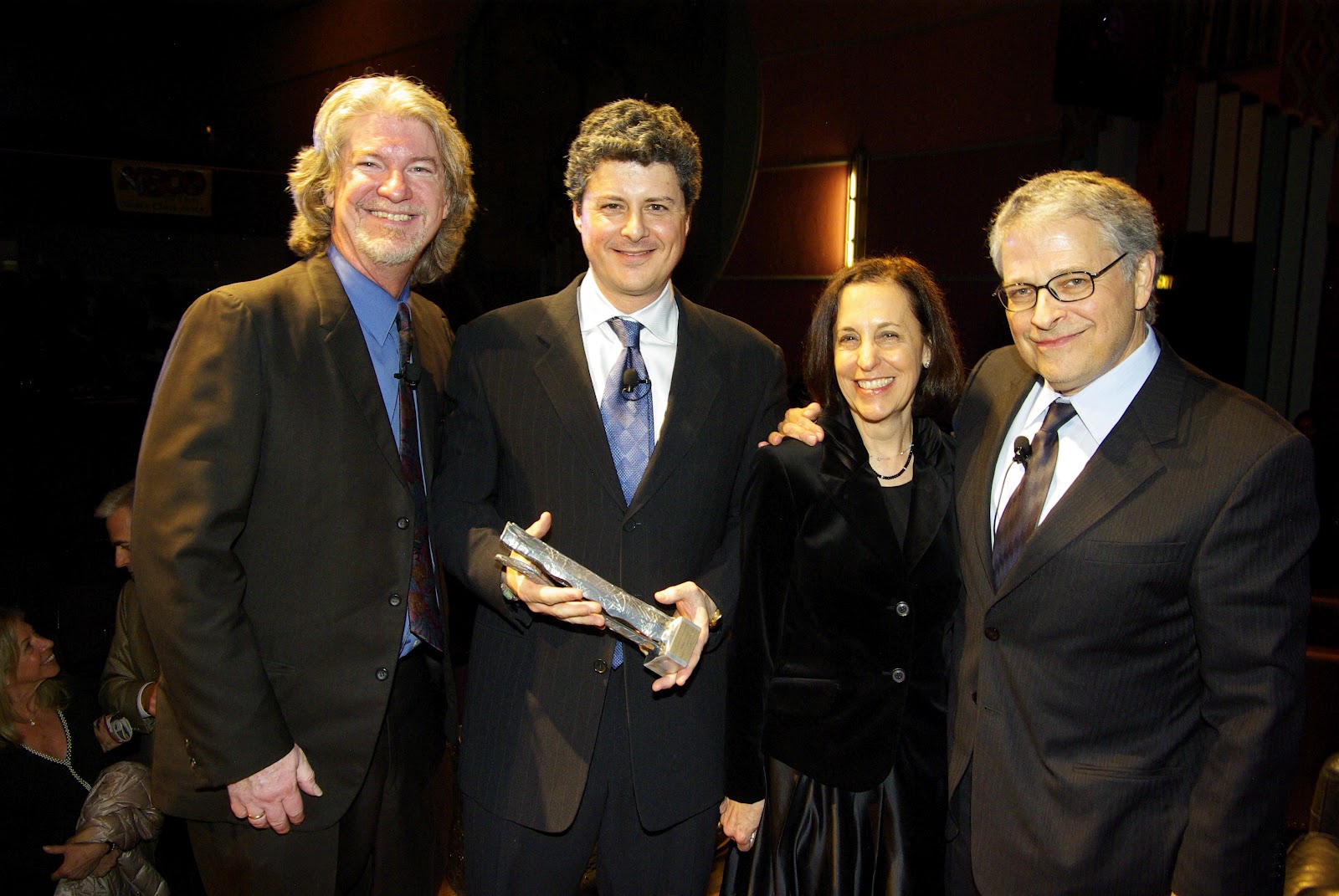
(From left) Producer and BIFF honoree Anthony Bregman, screenwriter Meg Kasdan and writer/director Lawrence Kasdan in front of the Boulder Theater on Opening Night of BFF 2012. [Photo by Randy Malone]

By Beth Kovacs, BCM BIFF News and Brad Weismann, BIFFDigiComm Director


The weather was cool but the jazz was hot as the Boulder InternationalFilm Festival kicked off its eighth year on Friday night. Once again, at thehistoric Boulder Theater, Bouldercelebrated its love for independent film.


Hot Club of Pearl Street entertains the crowd. [Photo by Peter Wayne]

The night started out with the musical stylings of the Hot Club ofBoulder jazz ensemble. The Big Red F Restaurant Group offered an array oftantalizing treats from local establishments as Jax Fish House and Zolo Grill,accompanied by wine from the Francis Ford Coppola Winery.


BIFF staffers line up for a bow. [Photo by Peter Wayne]

Soon the crowd was ready for the first film of the festival, “Darling Companion.” BIFF was honoredby the attendance of the film’s director, Lawrence Kasdan, and its producer,Anthony Bregman. Mr. Kasdan is known as the writer of “The Empire Strikes Back,”“The Return of the Jedi” and “Raidersof the Lost Ark” and as writer and director of the classics “Body Heat”and “The Big Chill.” Mr.Bregman is best known for producing such innovative films as “The Ice Storm,” “Thumbsucker,”“Eternal Sunshine of the Spotless Mind”and “Synecdoche, New York.”


[Photo by Peter Wayne]

Mr. Bregman accepted the BIFF Award for Excellence inProducing, and he, Kasdan and Meg Kasdan, writer of “Darling Companion,” satdown with BIFF Special Event Producer and Host Ron Bostwick for a chat and a Q& A with the audience.


BIFF's Ron Bostwick, Bregman, and the Kasdans. [Photo by Randy Malone]


“When you make a movie, you have 100 people saying ‘No’before you even begin,” said Kasdan in tribute to Bregman. “But an independentproducer doesn’t care about those no’s.”


Bregman said of the audience, “You got all the jokes, youunderstood where the story was going – if we could just package you and put youin every theater in America. . . “


Bregman descried his approach to producing as “director-driven”and lauded Kasdan as his moviemaking hero since Bregman was in junior highschool. Bregman described the creation of “Darling Companion” as a labor oflove for both him and Kasdan; the performers in the film, who included DianeKeaton, Kevin Kline, Dianne Wiest, Richard Jenkins and Sam Shepard, worked forbelow their usual rates and everyone got used to shooting three to four pages aday, as opposed to a customary two.


As to the mechanics of financing an independent project, Bregmantalked bout the delicate negotiating need to bring financing and talent together.“The money wants to know what the package is, and vice versa,” he stated.


[Photo by Randy Malone]
Lawrence Kasdan described his big break, the opportunity tocomplete the script for “The Empire Strikes Back,” as follows: “George Lucassat down with me and said, ‘You know . . . .Darth Vader is Luke’s father.’ AndI said, ‘No shit!!?’ I’m in!” He went on to talk about his many projects,circling back to describe his inspiration for his career as his viewing of “Lawrenceof Arabia” when he was 13.


Bregman countered with his story of inspiration – the lastscene of “Raiders,” when the box containing the Ark was hidden away in a vast government warehousefull of similar containers.


“I realized that each of those boxes was a story, and thatthere were thousands and thousands of stories to be told – and I just had tohelp tell them.”

CALL2ACTION: "Granito" 10 Activism Ideas

By Andy McLellan


In 1964, General Efraín Ríos Montt became the dictatorial leader of Guatemala. For the next 20 years, the indigenous Mayan population of the most populated country in Central America was subjected to an extended and brutal military campaign, secretly waged with the support of the United States government. Death tolls are estimated to be upwards of 200,000, an the 1998 Truth Commission in Guatemala City acknowledged the events as a genocide. "Granito: How to Nail a Dictator" is the story of bringing evidence against General Montt and serving justice. The country remains largely in the dark regarding the specifics of its recent history for many reasons, principal of which are to not admit to such atrocities and shelter Montt and other government and military leaders who are responsible.

Even today, in the highlands where the conflict was focused, it is not safe to discuss what happened. Malnutrition and misperceptions persist among the indigenous peasants, augmented by sustained army propaganda that insists it was they who saved the people against the armed insurgents. A lack of education is a major factor in the continued repression of these people.

But this documentary by Pamela Yates, and its predecessor, "When the Mountains Tremble", are not the only actions being taken. There are numerous organizations seeking to educate and enable Mayan communities in the highlands. This documentary was co-presented by Philanthropiece (www.philanthropiece.org) and Reading Village (www.readingvillage.org) as a part of the Boulder International Film Festival's call2action series, and they have identified 10 "Action Items" to encourage everyone to become involved:
1. Educate yourself! Learn more about the Guatemalan conflict and human rights violations by reading "Guatemala: Memory of Silence". http://shr.aaas.org/guatemala/ceh/report/english/toc.html
2. Show your solidarity with the Guatemalan people by signing the Justice for Genocide petition. http://www.thepetitionsite.com/415/justice-for-genocide-in-guatemala/
3. Donate to the Philanthropiece Scholars program in building the next generation of leaders for Chajul, Guatemala.http://www.philanthropiece.org/getinvolved.php#donate
4. Donate to Reading Village and support our mission to create leaders and to promote literacy in Guatemala.http://www.readingvillage.org/get-involved.html
5. Stay up to date with Philanthropiece's and Reading Village's work by following us on Twitter or liking us on Facebook.
6. Order this film to share with your personal networks and then donate it to a local middle school, high school, or university library. http://granitofilm.com
7. Invest 3 minutes! Watch "Granito, Every Memory Matters" about the film's sister project dedicated to building a digital library of firsthand accounts from the war. http://skylightpictures.com/films/granito
8. Connect with Antonio Caba of the Association for Justice and Reconciliation (AJR) to express your support. Send messages for Antonio to: inquiry@philanthropiece.org.
9. Be proactive about preventing future genocide and ethnic cleansing. Write your representatives in Washington, D.C. and share your outrage about human rights violations occurring around the world.
10. Create change! Become a documentary filmmaker - attend the BIFF workshop "Produce a Documentary" Sunday, Feb 19, 3-5pm at the Boulder Library.

Another organization working in Guatemala is Cultural Survival, who has established a network of indigenous community radio stations that facilitate communication, sharing, learning, unification, politicizing, and cultural survival. They can be found at www.cs.org.